Airlines are using AI alongside better catering data to reduce waste, improve forecasting, and give passengers more control over what they eat.
Artificial intelligence (AI) is giving airlines and caterers ways to better understand what passengers eat, improve forecasting, reduce waste, and give travelers more choice when it comes to inflight meals.
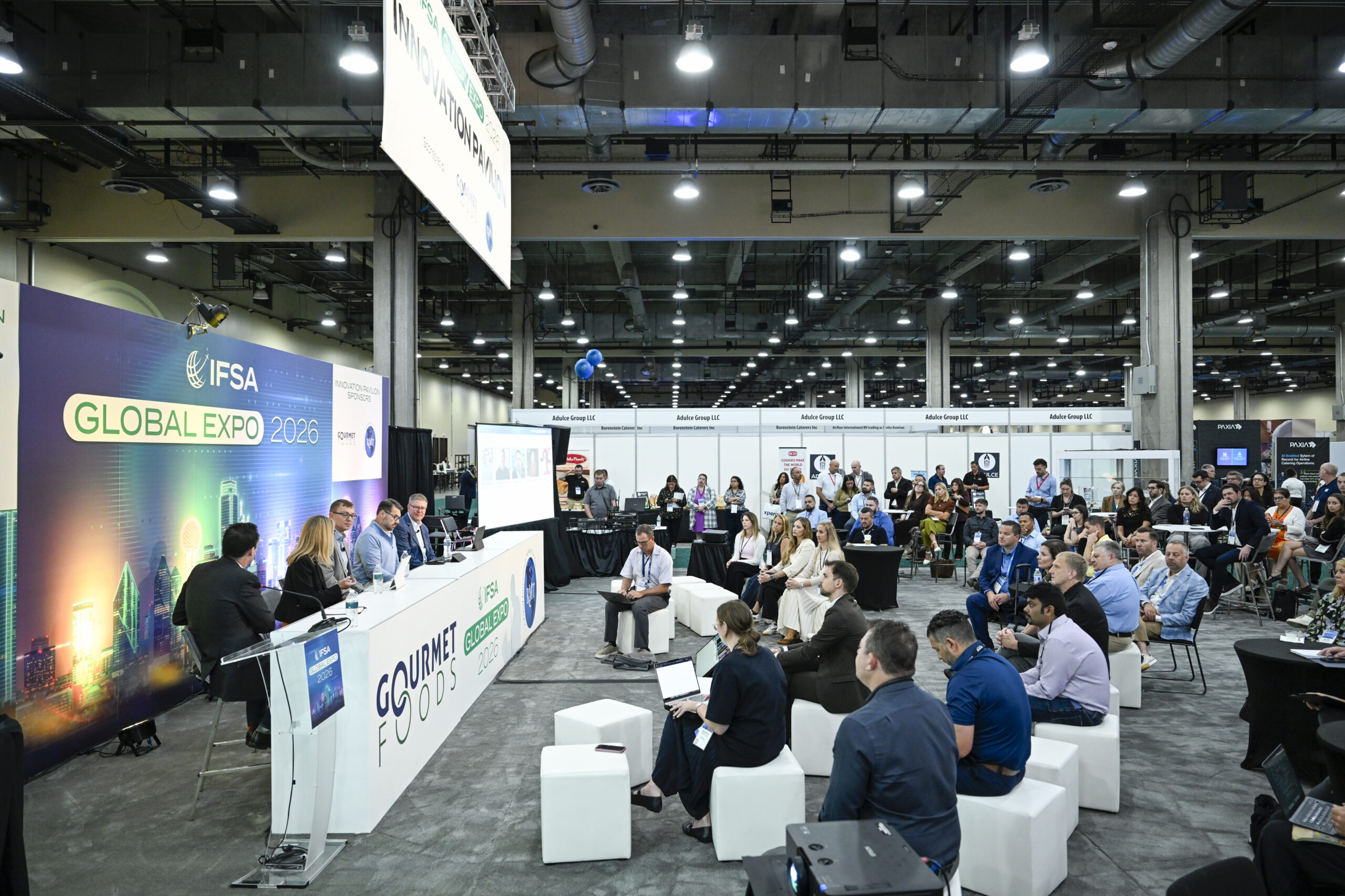
During a thought leadership session at the 2026 IFSA Global EXPO, “Turning Data into Dinner: How AI Is Transforming Airline Catering,” International Airlines Group (IAG) VP Strategy and Transformation Paul Mills moderated a panel featuring United Airlines Managing Director of Hospitality Programs Aaron McMillan, SkyChefs Chief Commercial Officer Tone Cresswell, Airbus Cabin and Cargo Architect Michael Bauer, and Paxia President and COO Rodney Duty.
The panel focused on one main challenge: airlines already collect large amounts of information, but turning it into better meals requires more accurate data, stronger connections between partners, and tools that crews can actually use.

Using AI to Understand What Passengers Actually Consume
United has already tested one way AI can answer a basic question airlines still struggle with: what passengers actually consume onboard. McMillan explained that the airline worked with SkyChefs to test camera technology and AI that tracked consumption habits on a particular flight over time. The results gave the airline a clearer picture of what passengers used and what came back untouched.
“It was really eye-opening,” McMillan said.
United then used that information to adjust how much product it loaded onto each flight. McMillan noted that the changes helped remove weight from the aircraft and reduce some costs without taking away from the passenger experience.
“We don’t want to put our flight attendants in a position where they have to tell the customer no,” he added. “But there’s ways that we can balance that out and do it smartly. I think the trick is how do we take that one pilot and test that we did and do it at scale.”
“We’re allowing customers to opt out, and we’re not boarding an entree for them currently, and it’s been going really well.”
Aaron McMillan, United Airlines
This kind of technology is helping airlines close one of the biggest gaps in catering data. Duty described consumption information as a “black hole” for the industry.
He went on to claim that such solutions need to go beyond knowing which meal someone has selected, suggesting airlines would benefit from learning which choices run out, what travelers wanted but could not get as well as what was returned untouched. Duty argued that airlines should capture that information as close to the flight as possible without creating another complicated task for flight attendants.
“If it becomes an overly onerous task that you have to convince crew or you have to incentivize crew,” he explained, adoption becomes much harder.
Bauer shared that Airbus is working on rolling out a solution to help crew efficiently track passenger consumption data. Known as “Smart Catering,” he confirmed the goal is to have the first version of the app on the market by the end of this year.
AI Is Only as Good as the Data Behind It
While AI drove much of the discussion, the panelists kept returning to the quality of the data behind it. “The key with AI in specific is it’s nothing without data,” Bauer emphasized. “You cannot use AI without the right data.”
He sees AI helping airlines improve planning, purchasing, production, delivery, and onboard service. Reducing waste can lower food costs, disposal costs, and aircraft weight, but Bauer argued that airlines should look beyond cost savings and also focus heavily on efficiency.
Once airlines improve the underlying data, they can use AI to build stronger loading and cost forecasts. Those results can then feed back into the system and improve future predictions. But, “If you have faulty data going into your analytics, your analytics coming out is going to give you misinformation,” Duty warned.
Sharing matters just as much as collecting more data. Airlines, caterers, aircraft manufacturers, and technology companies all hold different pieces of the catering process, and those systems do not always connect easily.
Bauer pointed to breaking down those silos and agreeing on more common standards as another major step for the industry. “Breaking up the silos, collaborating together, and making the data visible in a standard way” remains one of the bigger challenges, he explained.
Duty added, “We’ve come a long way from really siloed organizations […] to having more open architectures and API catalogs for partners to be able to access. I think that needs to be fostered in the technology groups within airlines, within the caterers and suppliers and within technology and equipment manufacturer providers. That will really help drive a feedback loop.”
“We are essentially chasing after a moving target every single day in order to get the right product on board on the right flight at the right time in the right location.”
Tone Cresswell, SkyChefs
Giving Passengers More Control Over Their Meals
More accurate forecasting can give passengers more choice without forcing airlines to load meals no one wants. United has expanded pre-order across its premium cabins and in economy on long-haul international flights. Passengers can already pre-order their main entree and pre-arrival meal, and McMillan noted that the airline plans to add appetizer pre-order. “We have really leaned into that space with our pre-order program today,” he said.
Cresswell added that some airlines want to shorten pre-order windows from roughly 20 to 24 hours before departure to around four hours. That would give passengers more time to decide what they want, but it would also require caterers to forecast demand more accurately and prepare meals closer to departure. “Having a dynamic load planner that can also be executed on is really something that would be cool to have a separate discussion on,” she said.
United is also testing a meal opt-out on a small number of flights. Someone who plans to eat in the lounge or sleep through a late-night departure can tell the airline not to load an entree for them. “We’re allowing customers to opt out, and we’re not boarding an entree for them currently, and it’s been going really well,” McMillan added.

Reacting Faster When the Plan Changes
Even the strongest forecast can change quickly once an airline starts operating for the day. McMillan described airline catering as a complex process that depends on communication between airlines, caterers, supply chains, and flight attendants.
“It’s not only having a great plan, but having a plan B and sometimes a plan C to react when issues occur along the way,” he explained. McMillan pointed to a tropical storm in Hawaii that disrupted United’s catering operation, forcing the airline to round-trip catering from San Francisco, Los Angeles, and Denver to support affected flights.
Cresswell described the same challenge from the caterer side. “We are essentially chasing after a moving target every single day in order to get the right product on board on the right flight at the right time in the right location,” she said.
Aircraft swaps, gate changes, passenger rebooking, and pre-orders can all change what a catering operation needs to deliver. A traveler may select a meal and then move to another flight, leaving the airline and caterer to figure out how to move that choice with them.
Cresswell pointed to more real-time flight and passenger information as one way to react earlier. “If we can get greater connectivity around all the players around how we are servicing aircraft, I think that will be extremely beneficial going forward,” she explained.
She argued that live flight feeds, passenger information, and better visibility into catering trucks and other resources could help teams react as the operation changes instead of waiting for information to move manually between companies.

Cutting Waste Without Taking Away Choice
Reducing waste remains one of the biggest opportunities presented by stronger catering data. During a Q&A at the end of the discussion, Cresswell estimated that food waste on some flights reaches around 20 percent, although she emphasized that the amount varies depending on the flight type and length.
Bauer referenced industry figures around a similar level while noting that overnight, domestic, international, and low-cost operations can produce very different results. He also stressed that airlines should look at waste as more than just a food issue.
However, the panelists noted that not everything that returns from an aircraft ends up as waste, and different products face different rules once they come back to the catering facility. “You have snack items. You have beverages that come back, you actually do recycle them,” Cresswell explained. “Not all of it is waste, even though it’s coming back from the aircraft.”
Perishable food creates a different challenge because hygiene and food safety rules can limit what airlines and caterers can reuse, giving airlines another reason to improve forecasts before food reaches the aircraft.
“I would like to see the gap between the consumer experience of interacting with AI and what the crew experience closing.”
Rodney Duty, Paxia Tweet
Giving Crews Better Tools
Passengers may never see much of the AI working behind their meal, but flight attendants could notice a major difference. “The crew is in the center of everything,” Bauer said. “They are in front of the passenger. They have to deliver.”
He sees technology giving crews clearer information about who ordered each meal, ingredients and allergens, where products sit in the galley, and how much inventory remains onboard. Instead of learning that an option has run out when the cart reaches the passenger, better information could help crews react earlier.
United sees another opportunity in how airlines load the aircraft. McMillan explained that airlines today often use rigid documents that tell catering teams exactly how to pack each aircraft, but more passenger information could allow United to move toward a more dynamic approach based on what people actually ordered.
He said that could help catering teams set up the aircraft in a way that makes service easier for flight attendants. That matters especially on long-haul flights, where McMillan noted that a business class meal service can take an hour and a half or longer.

“If you can do things differently, how can you really set them up for success?” he asked.
This element of the inflight catering process is something that Paxia is already using AI to explore, as evidenced in Duty’s recent interview with IFSA. He revealed that the company’s AI-assisted container naming is cutting the time needed to create organized galley storage for each aircraft by up to 30 percent.
A faster and more intuitive food and beverage service delivered by crew gives passengers more time to sleep, work, or spend the flight however they want, while giving the crew more time to focus on surprising and delighting airline customers, a win-win for both parties.
Duty concluded, “As consumers, we have so much that we’re able to access in our everyday lives, and I think there’s a gap today between that and what airlines are providing. On the ground, I can photograph my meal and then AI will tell me the ingredients, how it’s made and 17 different recipes to match that […] I would like to see the gap between the consumer experience of interacting with AI and what the crew experience closing in three to five years.”
To read a detailed summary of the “Premium by Design” panel session, which also took place during the 2026 IFSA Global EXPO, click here.