

In the lead-up to his appearance on the panel discussion titled “Turning Data into Dinner: How AI Is Transforming Airline Catering” during the 2026 IFSA Global EXPO, Paxia President & COO Rodney Duty shares how the company is harnessing the capabilities of artificial intelligence (AI) to provide its clients with increasing value.
Founded in 2000 and headquartered in Virginia in the US, Duty describes Paxia’s product as “the system of record for airline catering, with advanced configuration and automation capabilities built in.”
“The operational record is no longer the destination. It is also the raw material for better decisions.”
Rodney Duty, Paxia
The core benefit of its cloud-based platform is a “single, shared source of truth” between the airline and the caterer, “who have historically worked from separate records stitched together over email and spreadsheets,” he said. “A cloud platform lets both sides work from the same live data across the whole network, whether that is one station or fifty.
“For our customers, that means fewer reconciliation errors, faster onboarding of new stations, real-time visibility into what is happening across their operation, and a lighter IT burden because there is no on-premise software to maintain,” Duty continued.
Doing More with Data
While its solutions have always been “digital,” Duty acknowledged a recent growth in airline customer expectations as more data becomes available to them. “The operational record is no longer the destination. It is also the raw material for better decisions,” he explained.
“Customers still want and rely on that solid operational foundation, but they […] want to draw real analysis out of their catering data: finding opportunities to lower cost, increase revenue, detect anomalies, and forecast demand with far greater precision.”
Paxia has spent recent years evolving its capabilities to meet these demands. “A forecast is only as good as the data beneath it, and that data has always been our foundation,” Duty commented. “The real work has been on two fronts at once: curating and formatting that data set to power analytics; and building the analytics, forecasting models, and AI-enabled capabilities that run on top of it. We have done both.”
Three AI-Related Pillars Improving Paxia’s Products
Luckily, this growing expectation around Paxia’s competencies has come at a time when AI is both expanding what is possible and shrinking the timeframe needed to deliver new and innovative solutions.
Duty groups the company’s AI-related priorities into three key pillars. “The first is operational intelligence and predictive analytics: forecasting passenger numbers, menus, catering cost, and loadings,” he stated. “The point is not to make the call for the airline, but to put well-founded projections in front of planners so the decision they make is better informed.”
Although he emphasized that analytical and forecasting techniques have supported catering planning at Paxia for years, he recognizes that AI has drastically improved the process.
The second area of focus is the implementation of generative AI inside the workflow. “One live proof point is AI-assisted container naming in our Galleys module, which is cutting creation time by 25 to 30 per cent.
“Anyone attending the IFSA show is welcome to stop by for a live demonstration of our PAX.AI agents in action.”
Rodney Duty, Paxia
He elaborated, “Every physical item scheduled on a flight is packed into standardized containers and sub-containers: carts, whether full or half-size, along with trays, drawers, and racks that make up a flight galley load plan. Each container needs a name, and the real challenge is that the name has to be both descriptive and accurate while fitting within tight character limits. Getting that balance right by hand is the bottleneck. It is slow and repetitive work, and a single galley plan can involve dozens and dozens of containers, with an airline running multiple aircraft types and routes having to name thousands of them.
“In our Galleys module, the planner builds each container visually, dragging and dropping items into it. As they do, our AI reads the actual contents and suggests an appropriate name automatically, so the planner reviews and approves rather than crafting each name from scratch.
As well as saving time, Duty noted, “it standardizes how containers are named, and that consistency pays off well beyond the initial build. Container names become easier to search, and packing reports and labels take on a uniform, professional look that gives everyone who relies on them, crew included, a single clear and consistent view.

“We are also building into areas such as the tagging and classification of food items, work that is actively underway,” he revealed.
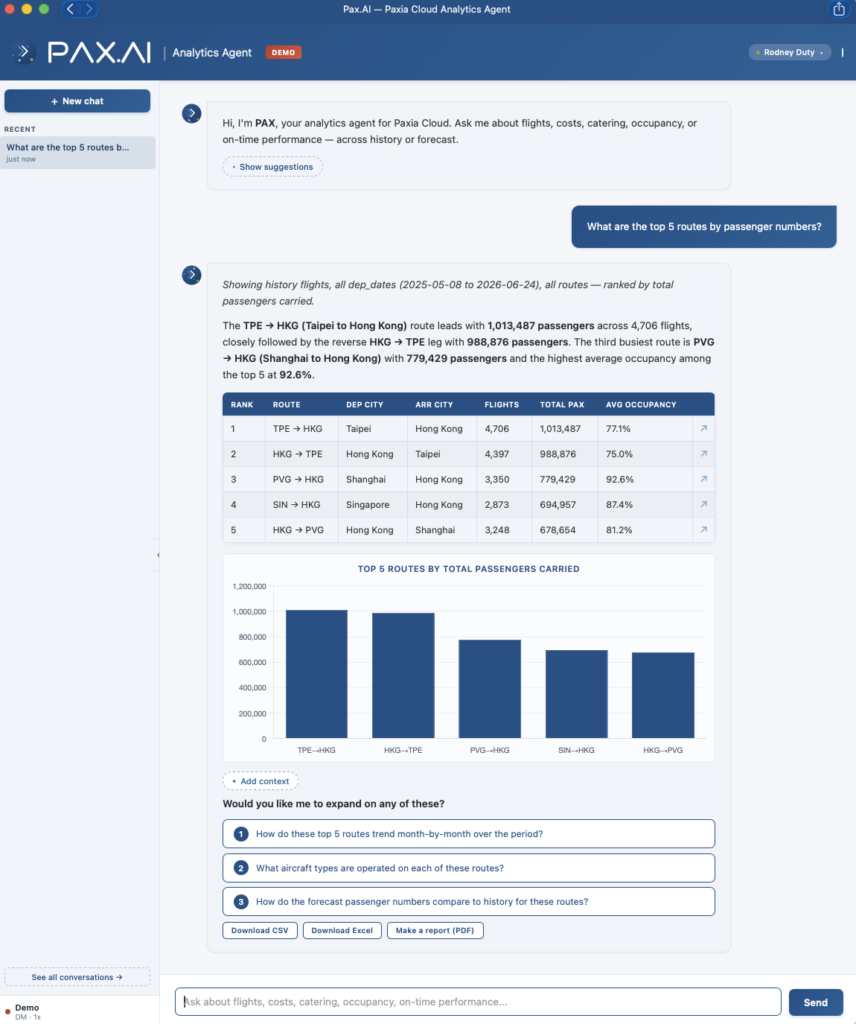
The final pillar centers on “intelligent assistants and automation, delivered through PAX.AI. That includes help agents built on the full breadth of Paxia Cloud product knowledge; analytics agents that sit over an airline’s complete dataset to let users ask questions in plain language and drill into the data on demand; and support agents that improve the end-user support and service experience.”
Paxia’s PAX.AI agents are built and functional, and currently in a pre-deployment pilot phase. They will begin becoming available to customers and prospects this year, with expanded capability continuing into 2027. “Anyone attending the IFSA show is welcome to stop by for a live demonstration of our agents in action,” Duty confirmed.
Meaningful Change is Needed Across the Industry
While AI is pushing the envelope in terms of what is determinable from collected data, ironically Duty believes a major industry challenge is that much insightful information is still untapped.
“One live proof point is AI-assisted container naming in our Galleys module, which is cutting creation time by 25 to 30 per cent.”
Rodney Duty, Paxia
“Valuable information often goes uncaptured altogether,” he stated. “Onboard consumption data by flight is a good example, and many proof-of-concepts are working to capture exactly that today.”
One of these is an app pioneered by Airbus due to enter the market by the end of this year, which is likely to be discussed by Duty’s co-panelist Michael Bauer during their session at IFSA Global EXPO.
Duty added that how data is captured is also an ongoing issue: “What is captured is often siloed or trapped in formats that are hard to search and harder to trust. That data is real potential left on the table.
As is usually the case, Duty advocates for “a shared goal and vision across every party in the catering supply chain,” arguing, “Airlines, caterers, and technology partners must pull in the same direction, because these hurdles won’t be solved by one party alone.”
Duty’s Thought Leadership Session, “Turning Data into Dinner: How AI Is Transforming Airline Catering,” will take place on Thursday, September 10 at 11:00 AM at the Gaylord Texan Resort & Convention Center in Dallas, Texas. To secure your tickets for the IFSA Global EXPO, click here.