Launched in 2010 by global, multi-platform media and entertainment company Mashable, June 30 marks World Social Media Day, which is designed “to celebrate the global impact of social media on how we communicate, share news, build communities, and run businesses.”
The airline industry, which is in the business of connecting people, offers a daily example of the ways in which social media can connect businesses with its customers across the globe.
"We connected this pop culture moment back to flying through humorous content and engagement via comments that grew our brand advocates."
United Airlines
It comes as no surprise, then, that airlines are responsible for some incredible social media campaigns, from WestJet’s “Christmas Miracle,” which has been going strong each year since 2013, to JetBlue’s “Reach Across the Aisle” social experiment in 2016 that saw polarized Americans made to find harmony and compromise in order to win a prize.
Somehow, a decade on from these cornerstone campaigns, carriers are still finding new and unique ways to capture people’s attention on social media each year, something IFSA has decided to highlight with a rundown of some of the most memorable airline social media campaigns in recent times.
Air Transat: Capitalizing on the World Cup
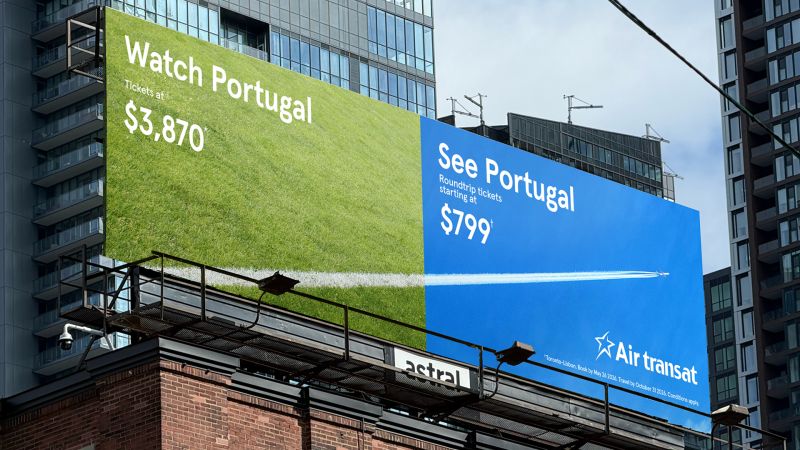
Air Transat was recently awarded the Best Ad Campaign of May 2026 by Ad Age for “Tickets-Tickets,” which directly responded to frustrations surrounding World Cup ticket prices.
Created together with its ad agency Courage Montreal, the out-of-home campaign used live data to compare the ticket price to watching a specific country play in the World Cup versus the cost of flying to the country itself with Air Transat. Spoiler alert: the latter was always the significantly cheaper option.
“The idea worked because it connected a real consumer tension to a real brand truth in a way that felt immediate, playful and instantly understood.”
Rafik Belmesk, Courage Montreal
“With ticket pricing becoming such a defining part of the fan conversation, we saw an opportunity to create work that didn’t interrupt culture, but existed naturally within it,” said Courage Montreal Partner and Head of Strategy Rafik Belmesk. “The idea worked because it connected a real consumer tension to a real brand truth in a way that felt immediate, playful and instantly understood.”
Although neither Air Transat nor Courage Montreal have released specific engagement figures for the campaign, it is widely perceived to have gained viral status across both LinkedIn, Facebook and Instagram via organic reach.
United: Pivoting at the Eleventh Hour to Stay Relevant
An in-depth case study by PR Daily charts the journey United Airlines went on when creating its “Mean Girls Day” campaign for October 3, 2025. It was originally set to be an homage to the 2004 film, referencing the scene where Cady mentions that school heartthrob Aaron asked her what day it was. The airline had lined up Jonathan Bennett, who played Aaron, to star.
However, as October 3 edged closer, the airline noticed online chatter anticipating the release of Taylor Swift’s new album on the same day. They didn’t ignore the development or scrap their original plans. Instead, “their solution was to rewrite the story so it reflected what was actually happening online, which added to the cultural moment.”
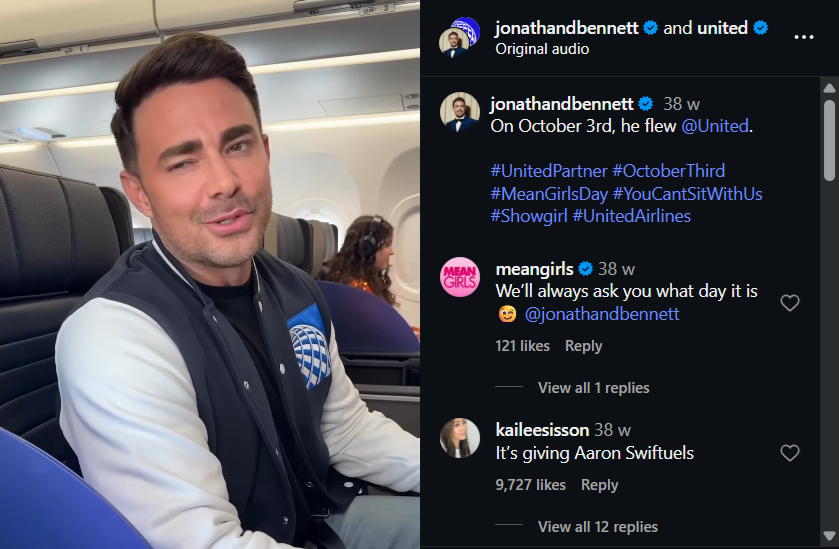
The resulting social content still focused on Bennett making Mean Girls references, but in the final version he is greeted with unimpressed and confused Taylor Swift fans.
In its entry for the 18th Annual Shorty Awards, which saw the airline listed as a finalist in the Community Engagement category, United said the campaign “became one of [its] top-performing engagement pieces of brand-owned content. While earning 15.5M views (13.5M organic).”
“This moment illustrates our unique approach,” it continued. “[Using] the overlap between our audience and cultural drivers Mean Girls and Taylor Swift, we connected this pop culture moment back to flying through humorous content and engagement via comments that grew our brand advocates.”
Jet2: Harnessing Unexpected Viral Success
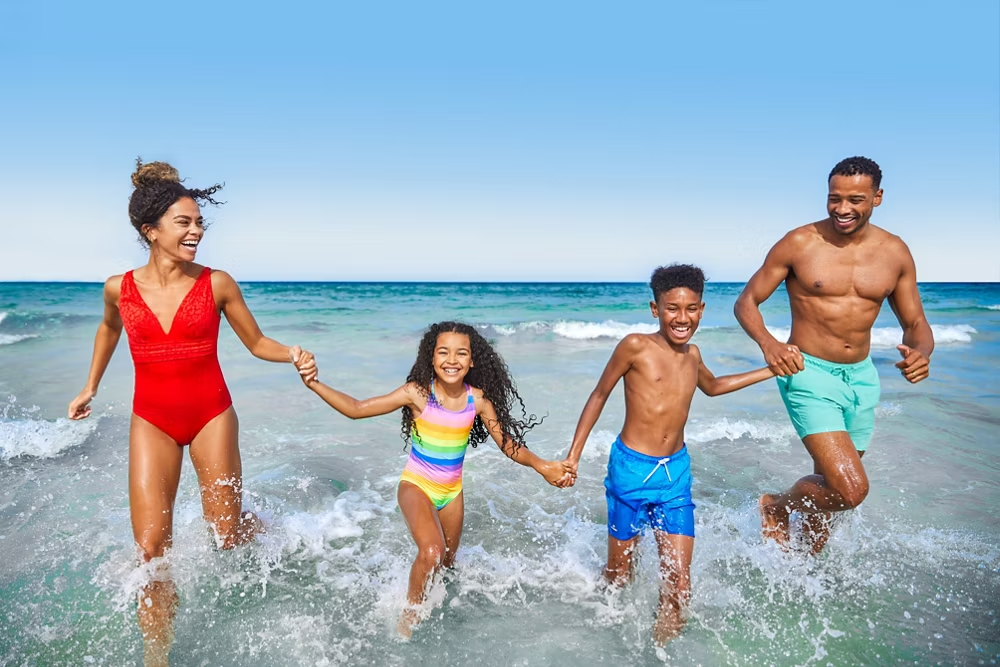
UK leisure airline Jet2’s familiar catchphrase, “Nothing Beats a Jet2 Holiday,” laid over the top of Jess Glynne’s “Hold My Hand,” which has been associated with Jet2 ads since 2015 and serves as the boarding music on Jet2 flights, began going viral towards the end of 2024, but not for positive reasons.
According to Good Morning America, TikTok users “collectively decided to use the viral audio to show off funny travel woes and epic fail videos, like getting dunked into the sea while parasailing or tourists getting knocked over by massive waves at a waterpark” throughout the summer of 2025.
While there is the argument that Jet2’s marketing turned against the airline, the resulting statistics are impressive, with the audio having now been used in over 2 million TikTok videos. And Jet2 leaned into the meme. For its social campaign last summer 2025, it launched a competition giving entrants who lip-synced along to its catchphrase, “Nothing beats a Jet2 holiday,” the chance to win airfare vouchers. According to Deepdiveplatform, “they tried to give structure to what had become wild social content.”
During Prolific North Live, a UK event for media, marketing, digital, and tech leaders, Executive Creative Director and Co-Founder of Supersonic Don McGrath, which has handled Jet2’s creative for nearly ten years, took to the stage to discuss the sudden explosion of its brand.
After introducing the Nothing Beats a Jet2 Holiday slogan in 2016, He argued “the campaign has been played out with relentless consistency, etching the song and the visual treatment onto hearts and minds. And that’s the key, the relentless consistency. As a creative, I spent years fighting my instinct to change things, to create something new. But we sat in so many focus groups where we kept hearing the same positive feedback and we realised that we had an idea that was built to last.”
And the relentless consistency continues, with Jet2 now encouraging customers to submit four-to-six second video clips for this year’s version of the campaign by the end of July to fully engage with and reward the best content creators.
That’s the key, the relentless consistency. As a creative, I spent years fighting my instinct to change things, to create something new.
Don McGrath, Supersonic
Social Success Comes from Engagement, Adaptability and a Good Sense of Humor
Each of these three campaigns, very different in both their approaches and outcomes, have many defining factors in common. Firstly, they engage in ongoing conversations being had by their customer base, tapping into trends outside their own worlds. This applies even when the discourse they are entering challenges the status quo or is negative in tone.
Furthermore, each carrier adapted their campaigns to meet their customers where they were at. In the case of Air Transat, instead of becoming an official World Cup sponsor and promoting the event, they tried to think outside the box. For Jet2, this meant trying to embrace the memeification of its brand identity, while for United it meant adapting a completed brand campaign to better reflect important cultural events.
In each case, the airlines refused to take themselves too seriously, showing that social media campaigns are best received when they are authentic to the brand voice but still self-aware and playful.