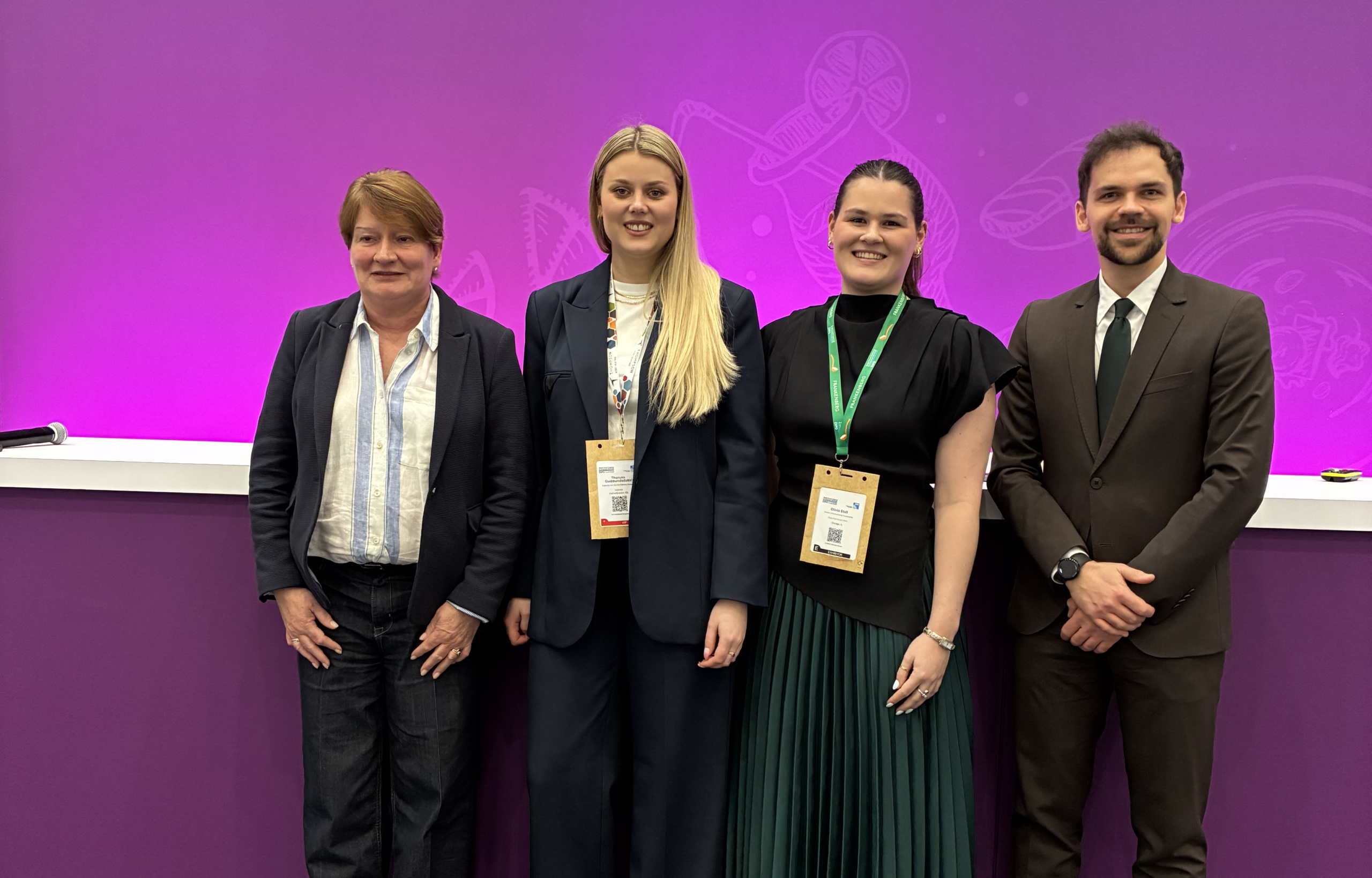
During the 2026 edition of the World Travel Catering & Onboard Services EXPO (WTCE) in Hamburg last week, International Flight Services Association (IFSA) Government Affairs Manager Marian Brestovansky moderated a panel discussion titled, “Sustainability as an Operating Requirement –Rethinking International Catering Waste (ICW).” To coincide with Earth Day, IFSA is sharing a recap of the discussion alongside information about its latest ‘Feeding the Skies’ advocacy initiative.
Joined onstage by Aviation Sustainability Forum (ASF) CEO Diana Cawley; Flying Food Group Director of Environmental Sustainability Olivia Stoll; and Icelandair Catering & Service Delivery Manager Þórunn Björg Guðmundsdóttir; Brestovansky talked about why it is so important that IFSA is working together with ASF, the Airline Catering Association (ACA) and the International Air Transport Association (IATA) to advance a new approach to ICW.
“We need a science-based, risk-aligned approach to ICW that allows aviation to actually participate in the circular economy.”
– Marian Brestovansky, IFSA
He outlined that IFSA’s core focus is “overcoming the ‘regulatory paradox’ that forces the industry into an unsustainable, linear waste model.” Brestovansky exemplified, “Despite the fact that the sector caters to 38.9 million flights and serves over 1 billion meals annually, outdated biosecurity laws, such as Category 1 Animal By-Product regulations legally mandate the incineration of massive amounts of recyclable materials and untouched food. In fact, data from ASF shows that over 18 per cent of global cabin waste consists of untouched, sealed food and beverages that are legally blocked from being recovered or recycled.
“We are working with ACA, ASF and IATA as a united front to ensure we represent the entire aviation ecosystem,” he continued. “ASF is leading the charge on vital data collection, while IFSA leverages that data to advocate for a fitness check of the regulations, building on important work done by IATA as part of a larger coalition on ICW. Together, we are driving a unified message to policymakers in Brussels and beyond: we need a science-based, risk-aligned approach to ICW that allows aviation to actually participate in the circular economy.”
To spotlight the scale of the problem, Cawley shared ASF data that suggests almost two thirds of all cabin waste comes from food and beverages, whether open or sealed. On a more positive note, she suggested that 30 per cent of an airline’s total cabin waste is recyclable, and that the aim now is to create infrastructure that allows the industry to indeed recycle it.
“The waste we handle is not the waste we create, however it is regulated the same.”
– Olivia Stoll, Flying Food Group
From a supplier perspective, Stoll agreed that Flying Food Group’s primary challenge comes from the fact that while airlines and caterers may be ready to make positive changes, state infrastructure and recycling capabilities are lagging behind, with rules and permissions varying by location. She added, “The waste we handle is not the waste we create, however it is regulated the same.”
The ideal scenario, she believes, is the creation of a Standard Operating Procedure (SOP) regarding the recycling of cabin waste with input from the aforementioned airline associations.
Looking forward, Stoll advocated for more recycling-related trials being initiated by airlines, as well as more cross-industry collaboration. For example, she highlighted that Flying Food Group is currently taking part in the US Department of Agriculture (USDA) Animal and Plant Health Inspection Service (APHIS) pilot programs regarding airline recycling and food waste run together with US Customs and Border Protection and IATA.
“There are limited sustainability benefits with the current setup.”
– Þórunn Björg Guðmundsdóttir, Icelandair
From an airline perspective, Icelandair’s Guðmundsdóttir stated that one of its biggest concerns was the growing expectations around sustainability in the aviation industry versus the reality of what it is able to achieve due to the fact that as well as differing recycling regulations across certain states, airports and waste contractors, not all airports have approved recycling streams for ICW at all. “There are limited sustainability benefits with the current setup,” she shared.
Where airlines are concerned, Guðmundsdóttir argued that the lowest hanging fruit in terms of encouraging recycling are to define onboard waste separation procedures and to train cabin crew accordingly. Furthermore, she said that when selecting packaging and materials for cabin products, airlines should be mindful of both their environmental footprint and potential recyclability.
Brestovansky gave attendees a practical example of the friction airlines and suppliers are facing. “In Europe, new Circular Economy mandates, like the EU’s Packaging and Packaging Waste Regulation (PPWR), are demanding that we reuse and recycle by 2030. But international biosecurity says otherwise. The sector cannot comply with environmental mandates if sanitary laws force the operators to burn waste.”
“We can no longer just treat this as an operational headache. It is a political problem, and it requires a political solution.”
– Marian Brestovansky, IFSA
“We can no longer just treat this as an operational headache. It is a political problem, and it requires a political solution,” he concluded, “We need regulations that are science-based, risk-aligned, and reflective of the modern aviation closed-loop system. The sector is doing its part […] Now, the law must catch up.
At the end of the session, Brestovansky revealed IFSA’s new ‘Feeding the Skies’ advocacy campaign, which IFSA is actively using to brief the European Commission and Members of the European Parliament on the topic of ICW. He clarified, “Our primary goal here is to trigger a formal ‘fitness check’ of EU biosecurity regulations like Regulation 1069/2009. We want to see low-risk items moved out of Category 1 restrictions so they can be safely recycled or reused.”
Moving forward, he added, “We also want to carry momentum from a recent work with the International Organization for Standardization (ISO). IFSA will be taking a seat at the table to help draft a new 3-year ISO ‘Industry Best Practice’ Technical Report for food loss and waste.”